Issue with average 200μA low power consumption in deep mode of sf32lb52-nano_n4

I am using the sf32lb52-nano_n4 development board and running the peripheral_with_ota example from the SDK.

Based on this example, I enabled the PM module and successfully captured the log indicating that hcpu entered deep sleep after startup.

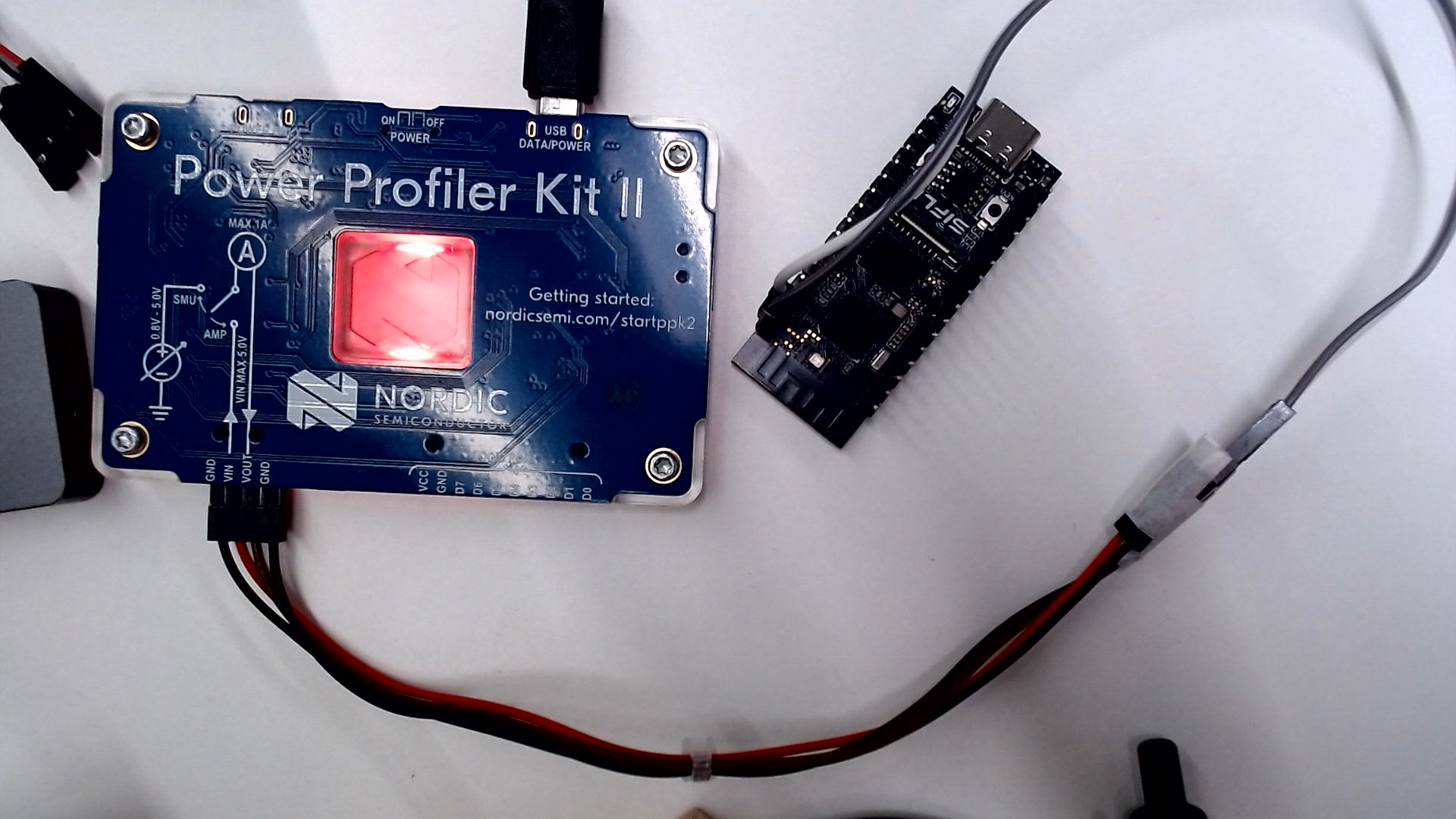
I want to test the chip’s power consumption in this scenario. I disconnected the development board’s serial port and used a PPK2 to output 3.3V and measure the current.

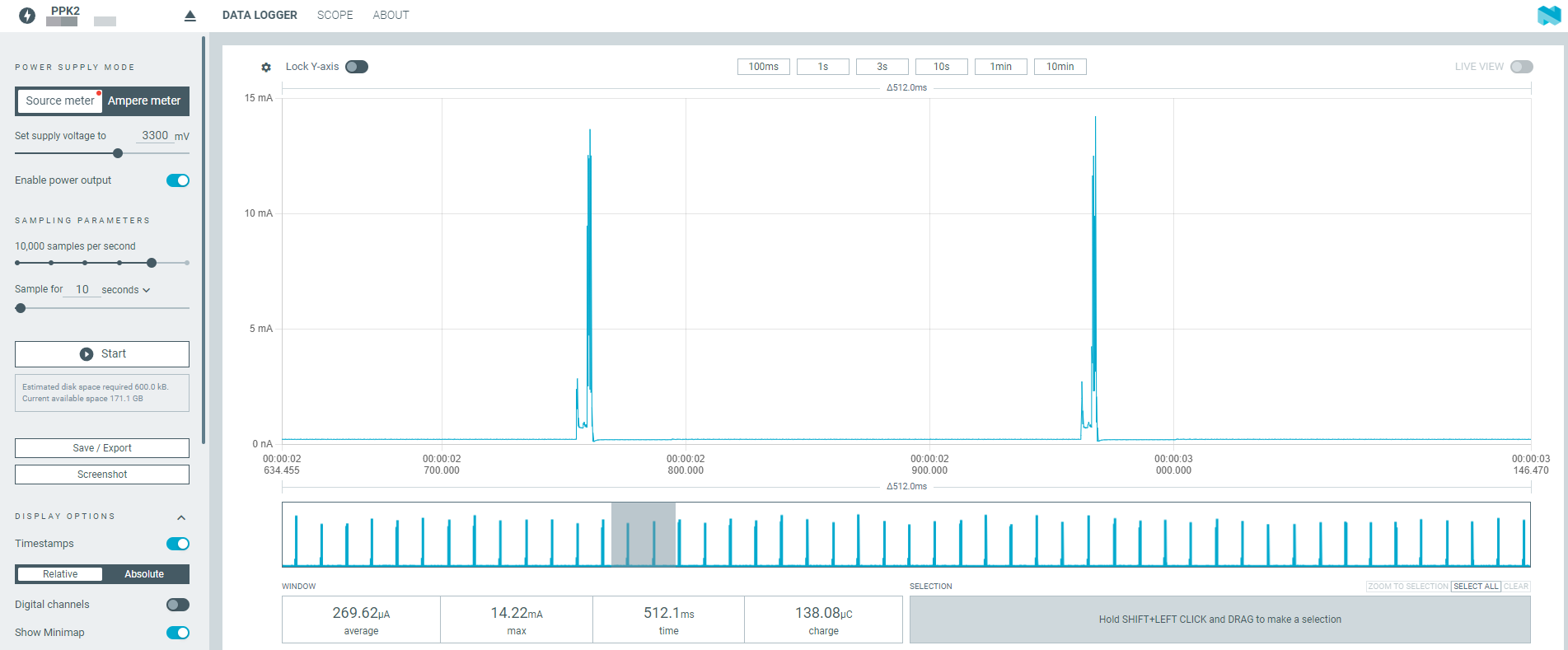
The average baseline power consumption is around 200μA, which is quite different from the 15μA baseline power consumption mentioned in the documentation.

On this board, I added a W25N01 and described it in ptab.yaml.

I performed the same test on another sf32lb52-nano_n4 development board without the added flash, and the average baseline power consumption was about 180μA.

Could you please tell me what possible reasons could cause the higher power consumption? The CSV measurement file from the PPK2 has been uploaded.

ppk-20260731T084858.csv (144.8 KB)

From the current waveform, this routine performs BLE broadcasting at regular intervals, and the transmission power is at least 10 dBm — it is not simply the baseline current. The interval between the two transmissions is where the baseline current appears.

Yes, I am using the peripheral_with_ota example. After startup, it only broadcasts. I just modified the broadcast interval. The transmit power parameter is filled with the default 0x7F, and I don’t know the exact value. From the current characteristics, it should be +10dBm.

Because the PPK software does not show the base current, only the average current, I uploaded a CSV file.

It can also be seen from the CSV file that the base current between two pulses is 200μA, and the average current after adding broadcast pulses is only 269μA.

The point of my question is actually this base current of 200μA. Because I tried testing on another identical development board without Flash, and the base current was also around 180μA. I looked at the LB52 power consumption test report, and in the deep state, the base current should be only about 15μA.

Because there are differences between the nano development board and the core development board, I am not quite sure where the problem lies here.

So I would like to ask if you could help me analyze the power consumption issue in conjunction with the hardware design differences of the development boards?

Could you tell me what possible reasons could cause high power consumption?
From the screenshots you uploaded, it’s clear that your base current is too high. The reasons for high base current usually include the following:

  1. There is leakage on the IO pins of the board (based on your description, this is likely the cause).
  2. Flash or PSRAM is not entering sleep mode.
  3. LCPU or some other modules are still active.

Because the PPK software doesn’t show the base current, only the average current.
You can use the mouse with the Shift key to select a custom area. Select the area between two pulses, and the displayed average current will be the base current.
Can you help me analyze the power consumption issue?
Regarding IO leakage, you can check the methods in this post. First, use a tool to roughly scan if the IO configuration is reasonable: 52 series, power consumption can be reduced in hibernate mode, but in deep sleep, power consumption is still several mA. How to fix - Q&A - SiFli BBS. Additionally, you can try running this example, which is an official low-power debugging example based on the core board. In this example, for the 52 series, the PA24 pin is connected to low level to exit deep sleep mode, and left floating to enter deep sleep: example\pm\bt

The prerequisite for scanning with the tool is that your chip has not yet entered deep sleep and is still in an awake state.

Thanks, after scanning, the tool reported an issue with my PA21: “IO output is high but the internal pull-down resistor is enabled, which may cause leakage.”

When initializing the IO, I set PA21 as output and pulled it high, and the quiescent current dropped to only 59μA, of which 30μA is the standby power consumption of the NAND.

By the way, the lightwork tool initially couldn’t read the registers of the nano board because the DTR/RTS configuration was incorrect.

After I used AI to modify the script, it could read them properly.

Thanks for the reply :heart: