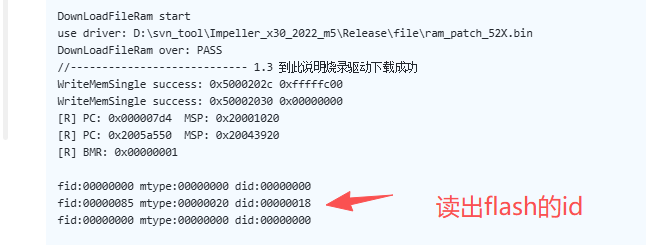
There are two boards in total, both using the XM25QU128C. The flashing driver should support them, and the circuit design is identical. Board A can be flashed normally, but Board B cannot. After swapping the flash chips, it turns out the flash chips themselves are not the issue—previously unflashable Board B can now run the program previously flashed onto the other board. This suggests that both power supply and communication should be fine. Could anyone help analyze where the problem might be?
After swapping the flash, the B board that couldn’t be flashed can now run the program burned into the A board, but it still cannot be programmed.
Could you please provide the burning log?
Most likely, there is an issue with the flash on board B:
- The flash is faulty.
- The flash IDs are different. Our driver matches the programming driver based on flash ID. You need to check the programming logs to confirm whether the IDs read from the two flashes are consistent. If the ID cannot be read and the power supply is normal, then there’s an 80% chance the flash is damaged.
If different IDs are read, verify your flash material.
To add a new flash, follow the procedure outlined in our documentation:
Flash Chip ID and Type Configuration Guide - SiFli-Wiki v1.0